Children’s literature has a special place in our hearts. In a way, recognizing it as a separate genre and branding a book as a children’s book is not right because many adults are just grown-up children. The true passion, the apparent silliness, alleged lack of knowledge and timelessness, the adults’ perception of having already experienced it — all of these are applicable to all literature. Age appropriateness may be a concern, but the associated risk can be mitigated at the source, that is, by producing it meaningfully (for which, again, the onus is on adults).
Even so, we are fortunate to have so much of wonderful children’s literature. One such book was written by Alexander Raskin: When Daddy Was a Little Boy. It has stories of a daddy when he was a little boy. They are told by a daddy himself to his young daughter when she used to fall sick. Here is an audio recording of how Raskin introduces his book:
When Daddy Was a Little Boy: Introduction (5 minutes)
Rujuta and Apoorv enjoyed almost all the stories. We have read them many times. Nothing fancy or grandiose, but simple, dramatic, and powerful. The stories are each less than 8 pages long and can be read in any order. Delicate humor and drama is a cornerstone of many stories and it brings out many aspects of the human psyche quite simply. Here is one of my favorite stories: Little Daddy Makes a Mistake.
Little Daddy Makes a Mistake (4 minutes)
We highly recommend this book to everyone, not only for a pandemic season, but for any season.
I decided to start composting! It definitely needs a lot of work, but I guarantee you it’s a lot of fun. Previously when I tried it, it turned to a big, smelly mess and I ended throwing out the whole thing. Clearly, I was missing a few things, so I turned to a friend (Gayatri Mavashi) who has 2 composting systems and over 50 plants. Here is a dated log:
12/17/2021 (17/12/2021) Today, I visited a friend who told me what I need to do to start a composting system. She showed me her own garden and her two types of composting. The first type she showed me was actually her own invention! The second type she showed me included a composting pit. She also showed me her collection of plants and told me that I could directly throw the waste in the plants once I got the hang of it.
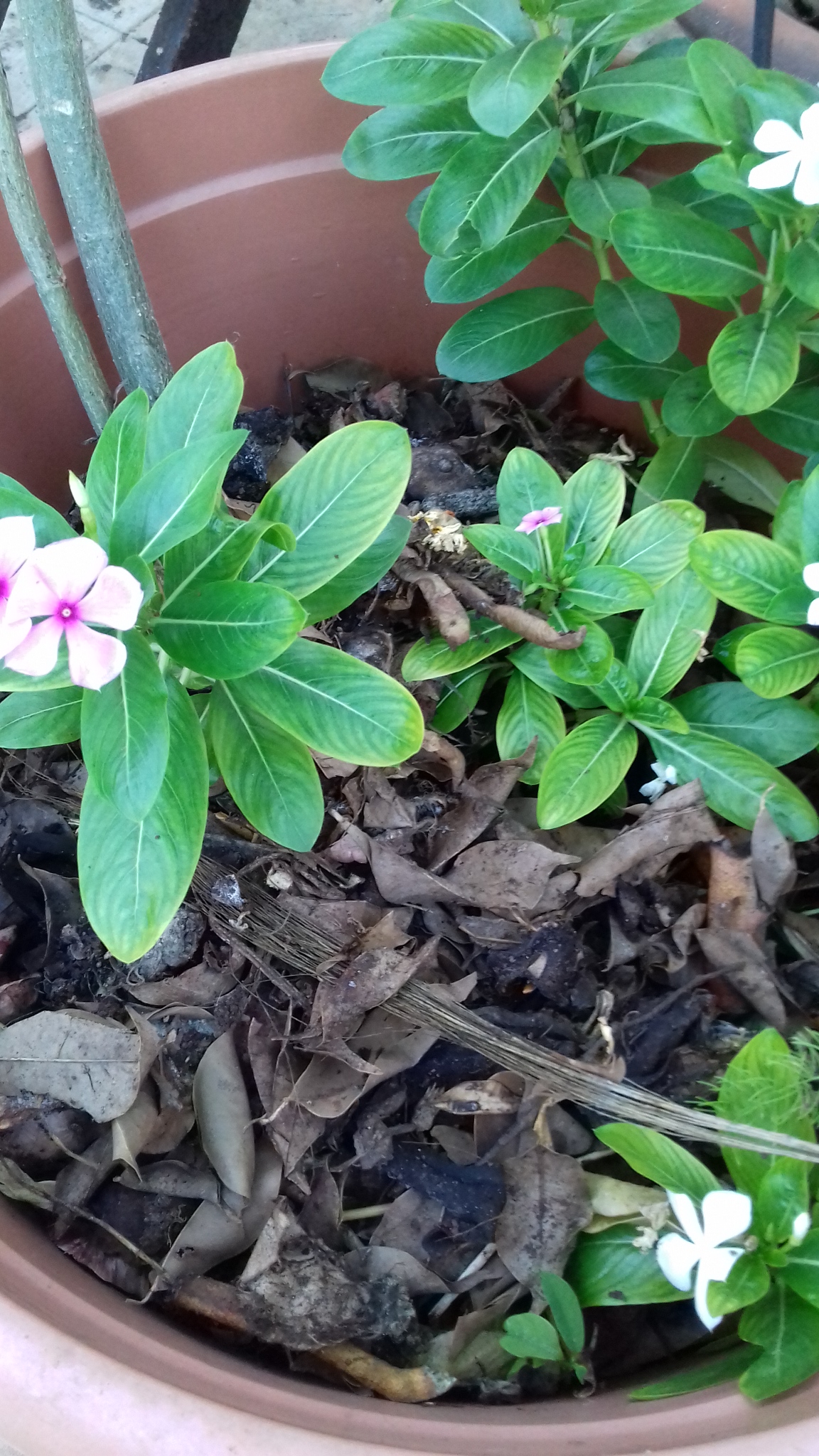
Any green waste like onion peels, lemon rinds, tea leaves can be put in the pot. She told me to add the waste and mix it every day and also out some soil every 2-3 days. To get some actual results from this project, it takes around 6 months. When you start, you are going to need some time to get the hang of it. It may fail the first few times, so do not despair! I needed a few things to start this project like extra soil and a good gardening set. I decided to continue on Tuesday, December 7th. According to Wikipedia, compost is a mixture of ingredients used to fertilize and improve the soil. It is commonly prepared by decomposing plant and food waste and recycling organic materials. You can read more about it here: Compost. Here are some photos of her garden and compost:
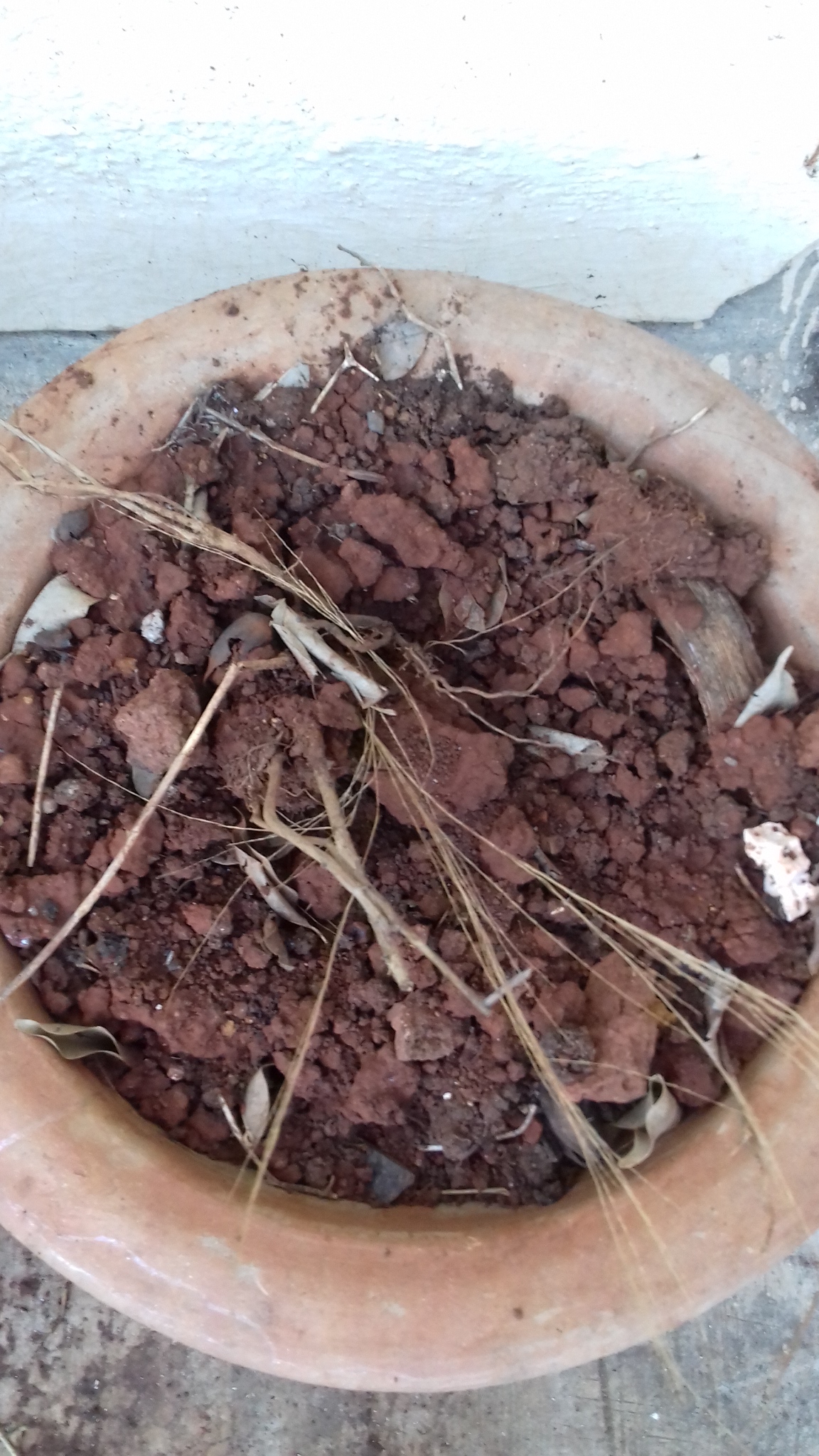
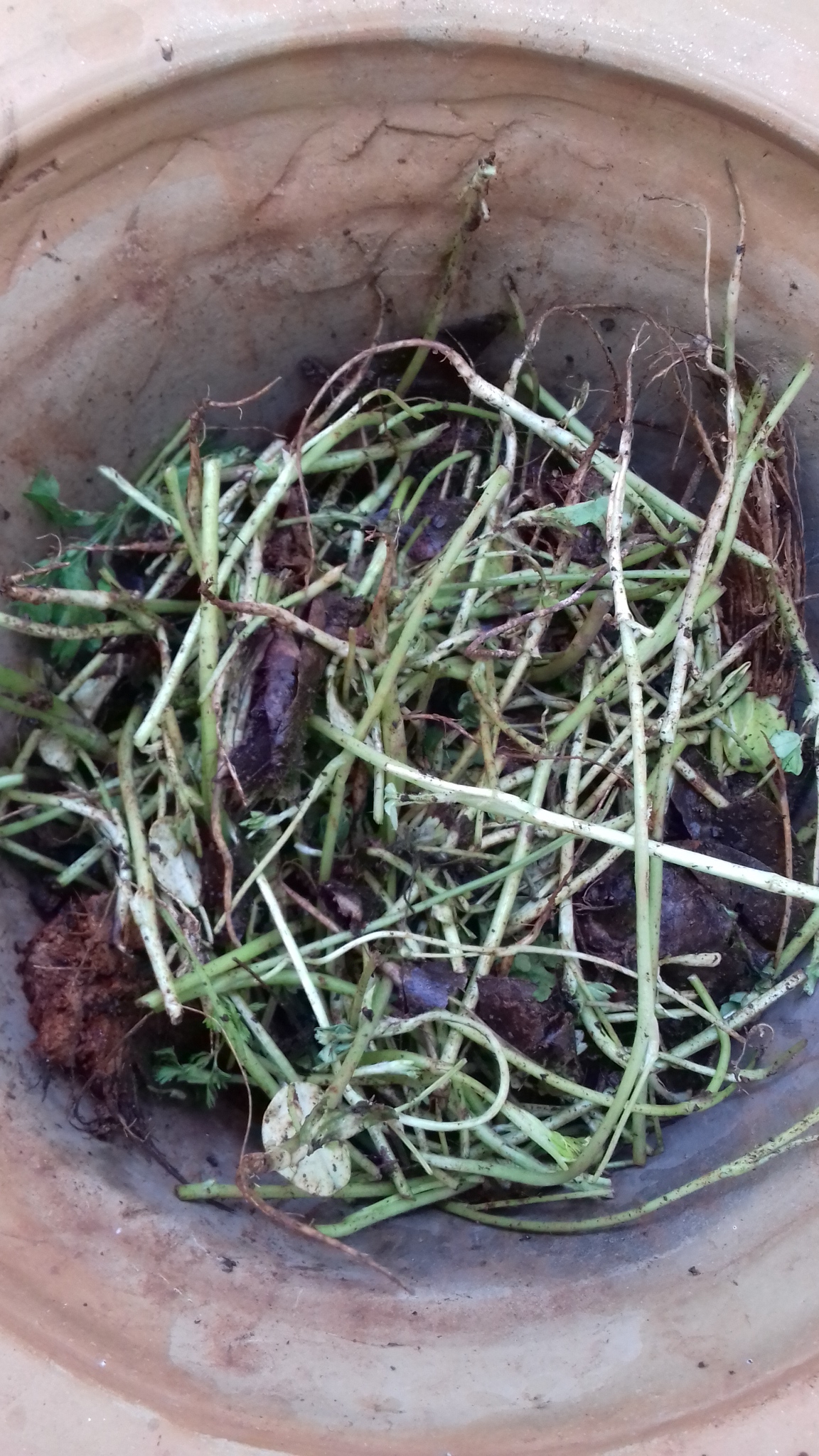
12/21/2021 (21/21/2021) Today, I actually started my composting! I already had an urban pot, the perfect size to start. I started by taking a newspaper, folding it into four parts, and securing it at the bottom of the pot. Next, I took the green waste I had, cut it into small parts, and dumped it in the pot. After that, I took some soil in which there were quite a few earthworms and dumped them into the part. Lastly, I mixed the compost with either a small rake or two small shovels.
Here are some photos:
Mix Composting Mixing the green waste and soil is very important in this type of composting. As you can see in the pictures, I put the layers of paper, the green waster, the soil, and then I finally mixed it. The last picture shows the mixed product. It does look a little messy, but that is how the compost is going to look; it’s normal. After a few months, take a look under all the compost and you might just find something.
Composting Pit In this type of composting, you need a big pit. The space in which I am going to start is too small to do this but it’s still an interesting idea. You need an area marked by stones or tiles. Fill the pit with soil and put your green waste in it. To mix this, you will need a big rake. Make sure you do it every day. Again, after a few months, take a look at the bottom of your pit and you might just find something.
When the ambience triggers a certain action in us, we say, “It’s in the air.” End of a year on the English calendar (and the Diwali time on the Indian calendar) is one such time when the ambience triggers a sense of giving in you. We are not physically up in the northern hemisphere right now, but the feeling still engulfs us.
Giving is a big topic with many connotations. In this blog-post, we are not going to go into why we want to give and how much. I am not a well-known philanthropist, but I don’t want to curb my enthusiasm of giving and then writing about how we carried out a very small session of giving.
I scheduled the “It’s Giving Time” event on the school calendar and everyone accepted the invite. I chose that we keep it simple:
Go to the beautiful and simple Amaya restaurant (located at the mouth of the Gokhale Institute of Politics and Economics in Pune) for breakfast.
List the charities that we are interested in donating money to. Each donor can pick as many charities as they want. Our budget this year is $150 per donor.
While picking a charity, there is no need to look at how popular a charity is. Just look at how indispensable it has been for you.
We reflected upon the past year of homeschooling (and before) and came up with the following:
In the above image, D, A, R, and K stand for our name initials. So, you can see that we are a DARK family and homeschool!
Everyone knows of Wikipedia and Khan Academy. I personally love Archive.org. It really is a treasure trove of all media, especially books (the way-back machine is just awesome and the way-forward machine is awesome too). Do you know pTable? It is, along with the periodic table of videos (and Prof. Poliakoff), the best resource for studying the periodic table of elements! My favorite text editor on the computer is Vim and our hats are off to computer programmers like Bram Moolenaar and Tim Pope. 3b1b and Grant have been absolutely phenomenal. SJPL, the public library of San Jose, has been extremely generous to us over the years. The OpenStax initiative by the Rice university has been very useful especially for our high school student. Solving the Project Euler is just so much fun! The MOOC revolution was fueled by the MIT Open Course Ware and OCW had to be on the list as well.
Thanks to all these wonderful people! We have received much, much more from them than what we are giving this year.
One of the joys of working with children learning mathematics (that means all of us) is to witness the accidental discoveries that they make. Let me narrate my experience of that in this rather long post.
The only way to learn mathematics is to do it. And doing mathematics is solving problems. In a delightful book that I will come back to at the end of this article, the following problem appears (reproduced here verbatim):
Problem 1. Several digits "8" and some "+" signs are inserted to get 1000. Figure out how it is done. (For example, if we try 88+88+8+8+88, we fail because we get only 280 instead of 1000).
Try to solve it before reading further (I have inserted a space-filling image below 😊). I guarantee, it would be a lot of fun. It will also be fun if you ask it to a ten- or eleven-year old and observe what she does.
Rujuta started to think about how to solve it. “Hmm, let’s see”, she said. After a few minutes (which we both spent patiently, as I was also trying to solve it in my head; this was not a material that I had reviewed before the class).
“Maybe I’d start with the largest number that is all 8’s but which is less than 1000”, she said somewhat speculatively. “That’s interesting, sure”, said I.
“That would be 888, which means I have 1000-888 = (after some time lag) 112 remaining”, she added.
[Here, she actually made a few calculation errors, but don’t get me wrong, she had no conceptual misunderstanding. Sometimes she ends up saying or writing 76 even if she means to say 66, or thinks of 72. Do you know if this is some kind of peculiarity that some people have especially with numbers?]
“Cool, now, we have 112 that we need to get using only 8’s”, was her next thought.
I was just witnessing her “thinking out loud process” and nodding to her efforts.
“That would be one 88 and now we have 12 + 12 = 24”.
“Ah, that is three 8’s”, she said, and then wrote, “888+88+8+8+8 = 1000“. She was giggling all along and as she finally discovered the solution, she was very happy.
Quite frankly, I was stunned. I had made (quietly) the mistake of expecting her not to do it so fast (yet another reason we should get rid of expectations of any kind).
And as I witnessed it happen, I was very happy as well. I said, “Wow! You did it, and in doing so, you accidentally discovered, or perhaps invented a technique called The Greedy Approach of problem-solving. This approach provides elegant solutions to several problems, although, at times, it may lead you astray. For example, how do you know beforehand if you would end up into 24 which is just three 8’s? Of course, you don’t, but you just press on in the hope that it may work in the end.”
She agreed with me. Indeed, the so-called greedy approach is effective is many situations.
Did you solve this problem this way? Perhaps you did. It is also possible that you solved it differently. No despair. All solutions are interesting. The problem itself is perhaps trivial for mathematically advanced students, nonetheless, it is very interesting.
I then proceeded to ask her, “What if the sum were 2000? Would you still use your greedy technique? That is, would you still look for the largest all-8’s number smaller than 2000 (which is still 888) and so on?”
She thought for a few moments and said, “Well, I need 2000. That is 1000+1000. I have already solved the problem for 1000 and I can solve it once more: 888+88+8+8+8 + 888+88+8+8+8. Isn’t it?”
I was pleased to say yes. This was indeed a useful observation. We then went on to think of what will happen were the sum 10000. She tried with 8888 first (she said that that was the largest all-8’s number smaller than 9000), arranged to get the remaining 112 (9000-8888) as 88+8+8+8 and then since she had already solved the problem for the sum = 1000, she reused that part of the solution.
After hearing both these answers I told her a mathematician joke:
A physicist and a mathematician are sitting in a faculty lounge. Suddenly, the coffee machine catches on fire. The physicist grabs a bucket, leaps toward the sink, fills the bucket with water, and puts the fire out. The next day, they are sitting in the same lounge. Again, the coffee machine catches on fire. This time, the mathematician stands up, gets a bucket, and hands the bucket over to the physicist, thus reducing the problem to a previously solved one.
Then I said to her, “That makes you a mathematician.” And she just chuckled.
The problem is taken from a book, Algebra, by two well-known mathematicians, I. M. Gelfand and A. Shen. This is a brilliant book for School Algebra (and beyond). I recommend at least referring to this book when introducing Algebra to middle school students. Here is the mathematician Richard Askey’s review of this book.
We went on to see their solution and here’s its verbatim reproduction:
Solution: Assume that
...8
....
....
...8
____
1000
We do not know how many digits are used in each number. But we do know that each number ends with "8" and that the last digit on the sum is "0". How many numbers do we need to get this zero? If we use only one number, we get 8. If we use two numbers, we get 6 (8+8 = 16), etc. To get zero we need at least five numbers:
....8
....8
....8
....8
....8
_____
1000
After we get this zero, we keep "4" in mind because 8+8+8+8+8=40.
To get the next zero in the "tens place" from this 4 we need to add at least two 8's since 4+8+8=20.
   8
   8
   8
..88
..88
____
1000
We keep "2" in mind and we need only one more "8" to get 10:
   8
   8
   8
  88
 888
____
1000
The problem is solved: 8+8+8+88+888=1000.
It is clear that the authors are subtly trying to introduce Algebra to middle schoolers. I went over this solution with her and she appreciated it, but quite naturally, she liked her own solution more!
I do think that the solution presented in the book has become (perhaps subjectively speaking) a bit more tedious than the greedy approach that Rujuta found. For example, it is not immediately clear if we need to take five 8’s or ten 8’s (or fifteen or twenty 8’s) to yield the zero in the units place of the sum since both satisfy the condition: 8×5=40, 8×10=80. Similarly, with the 4 carries, to get the zero in the “tens place” with two 8’s (as demonstrated above, 4+8+8=20) or with seven 8’s (4+8+8+8+8+8+8+8=60). We will clearly choose 4+8+8 first, but the point is that we need to examine many more cases (it appears to become like searching in a “tree”).
I let Rujuta know that I liked her solution more than the great Gelfand’s solution and she was somewhat flattered. But more importantly, she looked content. She looked happy. I thought she may enjoy such exploration more even though it is expected to be challenging. In the end, maybe, just maybe, the endeavor would turn out to be worthwhile. I had my little experience of what Francis Su calls Mathematics for Human Flourishing.
Having a good workout is very important to me. Even though I have online gymnastics, I make the most out of my workout every time I train. Whenever I have a really good workout, I am really happy and also really proud of myself. I agree that I do not always have the best time and that sometimes I get bored, but when I really do have a good workout, the feeling is amazing.
On Fridays, I have cardio. Cardio is a series of exercises that help get your heart rate up. Last Friday, the exercises in the cardio workout were not at all cardio exercises, so in the second round of the cardio, I decided to jog around the house. After a while, I noticed that my heart rate went all the way but to 187 bpm! This is the highest my heart rate has ever been.
After the whole workout, I proudly told my dad that I had a good workout and that I was proud of myself. He said that he was very happy that I was proud of myself and also said that he was proud of me.
I’ll be back next time with another blog post! Bye everyone!
Hi there! My name is Rujuta Mhaswade and I am back with another blog post.
Recently, I had my final exams! I was tested on four subjects: Mathematics, English Grammar and Composition, Science, and Music.
I had my Math exam first, my English exam next, my Music after that, and I my Science exam last. The general structure for all the exams was really good. I had a good time solving (and struggling with) the Math problems in my Math exam. As for my English exam, I had so much fun making a crossword and giving my family the opportunity to solve a crosswords I, myself, made. For my Science exam, I loved the fact that the questions were about my thoughts to some of the concepts in Science. Lastly, for my Music exam, I was tested by an “external examiner” (my grandmother!), who is a phenomenal singer (and teacher) of the Indian Classical Music and I am happy to receive an “A”!
On all of the exams my dad gave me, he always said that exams are not to embarrass you or dishearten you, they are just there to mark the progress that you have made and to make a note of things you need to work on. I completely agree with this! I observed that whenever had a time limit (my dad was just testing me on how I would do with a time limit), I stressed on how much time I had left and how many questions I had done and how many questions I had remaining. This showed me how much exams can stress someone in the normal school setting! Overall, I would say that I am happy with my progress and am going to keep working hard. Without further ado, on to the start of my summer break!
I am so excited for my summer break! I have so much time now, so I can do whatever I want. Even though it’s my summer break, I still think it should be a well planned summer break. I feel that I should organize my summer break using my calendar so that it’s a well-balanced summer!
Since I live in India, I feel like this “summer break” is more like a “monsoon break” because it is now Monsoon season in India! I have already had so much fun in my break. I go outside to play with my friends and I really hope that I can go back to my gym because I will get to do more gymnastics. I really hope that COVID-19 also stabilizes and people are more careful.
I hope that I have an awesome break and will have so much fun!
I’ll be back next time with another blog post. Bye everyone!
Yes, steacher is not an English word. I just defined it:
steach·er| ˈstēCHər noun: a person who teaches with an intention to learn, especially in an environment where freedom of expression is valued (past tense, past participle: steached) Such a person believes in a socratic style of teaching.
I have accepted the job of a full-time steacher at the Free Learner’s School. I consider it a privilege. I, along with the brilliant Deepa Joshi, will be steaching the new year 2020-21 at The Free Learner’s School. This post is rather long and it tries to deconstruct my decision to accept this job.
Perhaps traditional schools are great institutions. Students go there and make friends (sometimes lifelong), build memories, and, along the way, learn things that a curriculum dictates. The idea is that they learn something so that they can become capable to carry forward this wonderful world by developing some skills that society needs. In short, traditional schools are a somewhat natural outgrowth of humans’ need to learn and teach. We will not go into the history of traditional schooling here, however. Interested readers can refer to the excellent book, Free to Learn, by Peter Gray. Though Peter questions our blind faith in today’s traditional schooling, it is obvious that it is where a vast majority of us belong. So, traditional schooling will remain a big force in our lives for a foreseeable future, even when the 21st-century thinkers, entrepreneurs, and reformers rethink education in the era that is deeply influenced by technology.
I understand the confusion that you may have after reading the above on the blog of a homeschool! I want to stress that traditional schooling is here to stay. But that does not mean there are no alternatives. In our case, homeschooling appeared like the only choice. We moved from the United States to India in November 2018 in the middle of the school year. Our son was 13 and our daughter 9. It would have still been possible to make the children go through the drudgery of exam-oriented schooling and they might have gotten used to it just fine, but it simply did not feel like the right thing to do.
I started with this picture (Figure 1) which does not reflect the reality accurately, because, unfortunately, the data are much more skewed in the favor of traditional schools. I told them that we are embarking on the road that is (much) less traveled and that there were implications of that. One of the biggest implications is the social aspects. Although these are less acutely felt in the US, in India, homeschooling families are a very small minority and perhaps not well-accepted. It appeared, however, that the kids were comfortable to satiate their social needs via other, non-school ways of interacting with the world.
Figure 1. (With apologies to Scott M. Peck) Homeschooling: a road less traveled
I said, “When something feels right and also appears objectively sound, being in the minority gives you conviction and courage, but sometimes, being in the majority gives you strength.” We then asked them if they were willing to give it a try. I was not sure if they understood, but they were willing to give it a try nonetheless. Many acquaintances (all of whom were educated, well-meaning parents) doubted our audacity citing the common reasoning, “Do they really know [the answer to this question]?” Whereas I understand that children may not know about a subject of knowledge, how could we be so sure that they won’t know?
Someone has said, “It ain’t what you don’t know that gets you into trouble. It’s what you know for sure that just ain’t so.”
So, we decided to give it a try.
In the light of the Harvard Law Professor Elizabeth Bartholet’s critical and somewhat unfortunate analysis of homeschooling, I must clarify here that our family is not at all religious or a right-wing fanatic of some kind. We have always believed in science and humanity and humanists are what we are, although we are not as famous as the great Carl Sagan.
After such an introduction to homeschooling in August 2018, we practiced it for a few months before committing to it in 2018 after we moved to India. Deepa steached Geometry, Music, and Numeracy to our daughter and I was a part-timer introducing Computer Science to our son. You are more than welcome to ask the students, but we believe that they enjoyed the whole experience and their childhood is something that they will remember fondly.
It must be kept in mind, however, that homeschooling is a lot of work, but it is also a lot of fun. The mathematician Richard Guy has said, “It is an old adage that you don’t really understand something until you teach it to someone else.” As a result of this, steachers at homeschools need to first understand things and then they have the privilege to explain it to students. If you are too bothered (it is quite understandable as depicted by the student’s father in this wonderful Hindi movie “तारे जमीन पर” ) by the thoughts of schooling success, cramming children’s minds with knowledge that they don’t have much connection with, and making them tomorrow’s responsible workforce even before they have lived their childhood in freedom, then you may be better off with a traditional school. The child may suffer through the environment of often misplaced discipline, strict compliance, stereotyped thinking, and dishonesty, but it may help them survive in the harsh reality of the world. It is also quite probable, however, that the child may turn into a youth that embodies the same principles that traditional schools reinforce. Of course, I am not suggesting that this is what will happen, I am just saying that it is possible or even probable.
No, this is not bashing of traditional schooling. In general, I am not interested in comparing these two ways of schooling because that is a much broader topic any amount of discussion on which may be inconclusive (if we were to choose a winner). Any of the above (apparently negative) characteristics may well be demonstrated by homeschooled kids.
Good traditional schools and good teachers are irreplaceable, but they are also rare. All I want to say is alternatives exist in shaping a child’s future and homeschooling may create the kind of world citizens that we want with a more-or-less similar probability as traditional schools. After all, like Malcolm Forbes has said,
The purpose of education is to replace an empty mind with an open one.
An enabling factor for such an undertaking is freedom. And the essence of freedom is in giving it to others when you are in a privileged position. Such freedom is perhaps hard to accept until one groks it. It makes one have no expectations from anyone (even yourself). When you are starting a school with freedom as a (and probably the only) core principle, it is better to be absolutely clear about it. Of course, you want to impart the love of learning to children and help them discover themselves. But if doing so comes at the cost of their freedom, then it is worthless and sad.
This does not mean one should not be undertaking hard work, the motive force behind any success, and perhaps happiness. It does not mean that the moment someone is experiencing hard work they should back off, do some deceptive soul-searching, and look for an alternative like a fleeting creature. It only means that hard work should become a way of life once the personal connection with the present circumstances has been firmly established.
So, with that in mind, I have begun my adventure. It has been an adventure because I have no idea how it will turn out to be. My only hope is that the time will be spent well and looking back we will have fond memories of this time.
On this blog, we (steachers) will discuss such things as:
Intended meaning of some important terms (e.g. examination, society, work ethic, discipline, compliance, respect, sincerity, etc).
Administrative aspects of homeschooling (remember, homeschooling is a lot of work) and it may help others to find out what seems to work for us.
Actual experiences while learning and teaching something and how the learning seems to take place. These would be quite detailed.
Students’ expressions.
Book reviews and personal reflections.
Tools that we use for various subjects and school administration (management).
I hope I continue to post my experiences now that the adventure has begun.
Hello there! My name is Rujuta Mhaswade and today I going to ask you an amazing math problem.
My dad and I were taking a walk and he asked me this problem (we even wrote it with a chalk on the sidewalk):
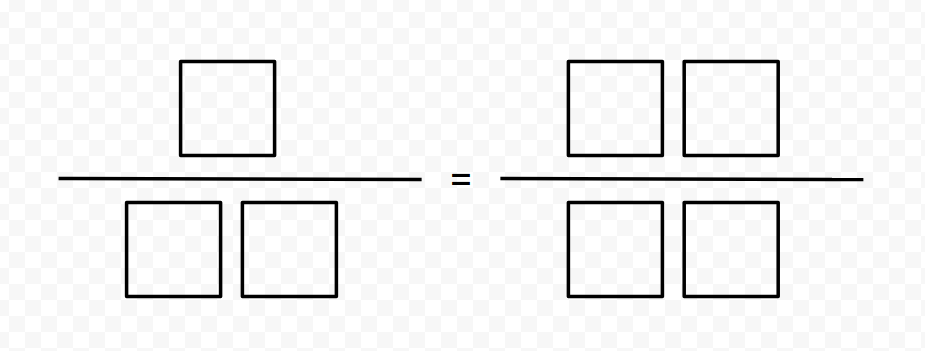
Math Problem: Use the digits 0-6 exactly ONCE (i.e. the seven digits: 0, 1, 2, 3, 4, 5, 6) to make this equation true.
I think everyone should give this problem a try, and, as Clifford Pickover typically says on his Twitter, you’ll shiver in ecstasy when you get the answers.
My dad later told me that there are 6 solutions to this problem (he wrote a computer program to verify). But a funny thing is that he couldn’t solve all of them in his head or on paper. More importantly, he couldn’t realize an important characteristic of this problem: If you get one solution, you should get another solution almost immediately. Do you see why?
Hello! This is Rujuta Mhaswade and I am back for another blog post. Today’s blog post will be about my First Day of Sixth Grade.
I could tell, first moment I started my day, I knew it was going to be an amazing year…
I was rummaging through some boxes that had books in them and I came across a very nice and interesting book. The book was called “Without Words” by James Tanton. The book has absolutely no words whatsoever, although it may have numbers. I opened it, started browsing through it, and found many problems that I was sure I would have fun solving. I couldn’t stop reading it. I kept finding more and more interesting problems.
I started my first session of the year with some Math. I am reading this book called The Number Devil. I have just gotten to the second chapter and I already think it is an amazing book. It’s a very nicely written book and is also very funny.
Hello! I am Rujuta Mhaswade and I am part of the Free Learner’s School.
This is a new year that I am sure I will enjoy. I am excited to learn many new things. This year I will be doing a lot of Math, English Language Arts, Science, and more! One thing that I think everyone should keep in mind is that learning should be fun. I think that once you have decided that you want to solve a problem, you should make every attempt to understand what is asked. There is no point in answering a question that you do not understand. Learning should be fun.
I am in 6th grade now. I am excited for my first year of Middle School. I hope to have an amazing year and to learn many new things!






 Free Learner's School