
Yes, steacher is not an English word. I just defined it:
steach·er| ˈstēCHər noun: a person who teaches with an intention to learn, especially in an environment where freedom of expression is valued (past tense, past participle: steached) Such a person believes in a socratic style of teaching.
I have accepted the job of a full-time steacher at the Free Learner’s School. I consider it a privilege. I, along with the brilliant Deepa Joshi, will be steaching the new year 2020-21 at The Free Learner’s School. This post is rather long and it tries to deconstruct my decision to accept this job.
Perhaps traditional schools are great institutions. Students go there and make friends (sometimes lifelong), build memories, and, along the way, learn things that a curriculum dictates. The idea is that they learn something so that they can become capable to carry forward this wonderful world by developing some skills that society needs. In short, traditional schools are a somewhat natural outgrowth of humans’ need to learn and teach. We will not go into the history of traditional schooling here, however. Interested readers can refer to the excellent book, Free to Learn, by Peter Gray. Though Peter questions our blind faith in today’s traditional schooling, it is obvious that it is where a vast majority of us belong. So, traditional schooling will remain a big force in our lives for a foreseeable future, even when the 21st-century thinkers, entrepreneurs, and reformers rethink education in the era that is deeply influenced by technology.
I understand the confusion that you may have after reading the above on the blog of a homeschool! I want to stress that traditional schooling is here to stay. But that does not mean there are no alternatives. In our case, homeschooling appeared like the only choice. We moved from the United States to India in November 2018 in the middle of the school year. Our son was 13 and our daughter 9. It would have still been possible to make the children go through the drudgery of exam-oriented schooling and they might have gotten used to it just fine, but it simply did not feel like the right thing to do.
I started with this picture (Figure 1) which does not reflect the reality accurately, because, unfortunately, the data are much more skewed in the favor of traditional schools. I told them that we are embarking on the road that is (much) less traveled and that there were implications of that. One of the biggest implications is the social aspects. Although these are less acutely felt in the US, in India, homeschooling families are a very small minority and perhaps not well-accepted. It appeared, however, that the kids were comfortable to satiate their social needs via other, non-school ways of interacting with the world.
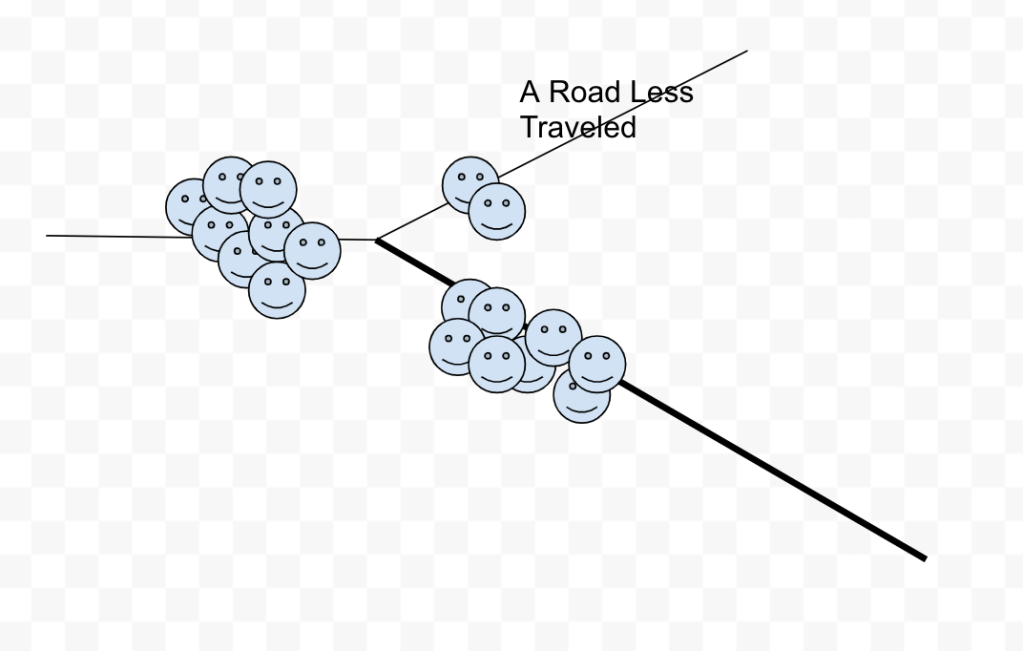
I said, “When something feels right and also appears objectively sound, being in the minority gives you conviction and courage, but sometimes, being in the majority gives you strength.” We then asked them if they were willing to give it a try. I was not sure if they understood, but they were willing to give it a try nonetheless. Many acquaintances (all of whom were educated, well-meaning parents) doubted our audacity citing the common reasoning, “Do they really know [the answer to this question]?” Whereas I understand that children may not know about a subject of knowledge, how could we be so sure that they won’t know?
Someone has said, “It ain’t what you don’t know that gets you into trouble. It’s what you know for sure that just ain’t so.”
So, we decided to give it a try.
In the light of the Harvard Law Professor Elizabeth Bartholet’s critical and somewhat unfortunate analysis of homeschooling, I must clarify here that our family is not at all religious or a right-wing fanatic of some kind. We have always believed in science and humanity and humanists are what we are, although we are not as famous as the great Carl Sagan.
After such an introduction to homeschooling in August 2018, we practiced it for a few months before committing to it in 2018 after we moved to India. Deepa steached Geometry, Music, and Numeracy to our daughter and I was a part-timer introducing Computer Science to our son. You are more than welcome to ask the students, but we believe that they enjoyed the whole experience and their childhood is something that they will remember fondly.
It must be kept in mind, however, that homeschooling is a lot of work, but it is also a lot of fun. The mathematician Richard Guy has said, “It is an old adage that you don’t really understand something until you teach it to someone else.” As a result of this, steachers at homeschools need to first understand things and then they have the privilege to explain it to students. If you are too bothered (it is quite understandable as depicted by the student’s father in this wonderful Hindi movie “तारे जमीन पर” ) by the thoughts of schooling success, cramming children’s minds with knowledge that they don’t have much connection with, and making them tomorrow’s responsible workforce even before they have lived their childhood in freedom, then you may be better off with a traditional school. The child may suffer through the environment of often misplaced discipline, strict compliance, stereotyped thinking, and dishonesty, but it may help them survive in the harsh reality of the world. It is also quite probable, however, that the child may turn into a youth that embodies the same principles that traditional schools reinforce. Of course, I am not suggesting that this is what will happen, I am just saying that it is possible or even probable.
No, this is not bashing of traditional schooling. In general, I am not interested in comparing these two ways of schooling because that is a much broader topic any amount of discussion on which may be inconclusive (if we were to choose a winner). Any of the above (apparently negative) characteristics may well be demonstrated by homeschooled kids.
Good traditional schools and good teachers are irreplaceable, but they are also rare. All I want to say is alternatives exist in shaping a child’s future and homeschooling may create the kind of world citizens that we want with a more-or-less similar probability as traditional schools. After all, like Malcolm Forbes has said,
The purpose of education is to replace an empty mind with an open one.
An enabling factor for such an undertaking is freedom. And the essence of freedom is in giving it to others when you are in a privileged position. Such freedom is perhaps hard to accept until one groks it. It makes one have no expectations from anyone (even yourself). When you are starting a school with freedom as a (and probably the only) core principle, it is better to be absolutely clear about it. Of course, you want to impart the love of learning to children and help them discover themselves. But if doing so comes at the cost of their freedom, then it is worthless and sad.
This does not mean one should not be undertaking hard work, the motive force behind any success, and perhaps happiness. It does not mean that the moment someone is experiencing hard work they should back off, do some deceptive soul-searching, and look for an alternative like a fleeting creature. It only means that hard work should become a way of life once the personal connection with the present circumstances has been firmly established.
So, with that in mind, I have begun my adventure. It has been an adventure because I have no idea how it will turn out to be. My only hope is that the time will be spent well and looking back we will have fond memories of this time.
On this blog, we (steachers) will discuss such things as:
- Intended meaning of some important terms (e.g. examination, society, work ethic, discipline, compliance, respect, sincerity, etc).
- Administrative aspects of homeschooling (remember, homeschooling is a lot of work) and it may help others to find out what seems to work for us.
- Actual experiences while learning and teaching something and how the learning seems to take place. These would be quite detailed.
- Students’ expressions.
- Book reviews and personal reflections.
- Tools that we use for various subjects and school administration (management).
I hope I continue to post my experiences now that the adventure has begun.
 Free Learner's School
Hey, Kedar! Didn’t know that you moved to India and now homeschooling your children! That’s great! I homeschooled my daughter and she is starting college this year. I’m sure you and your wife are awesome teachers!
LikeLiked by 1 person
Thanks Jane! I had seen Keona’s update on Facebook! Amazing achievement. Congratulations again!
LikeLike