A Fun Math Quiz

Rujuta wanted a math quiz. She is now in the eighth grade and has studied arithmetic, some algebra, and some geometry. She enjoys the process of discovery. Of course, like everyone else, she has some blind spots. But one thing that I really admire about her is that she gives it her everything. She is upset with herself when she makes a silly mistake or when she doesn’t get a (difficult) question. Her evolution as a “math person” is heartwarming.
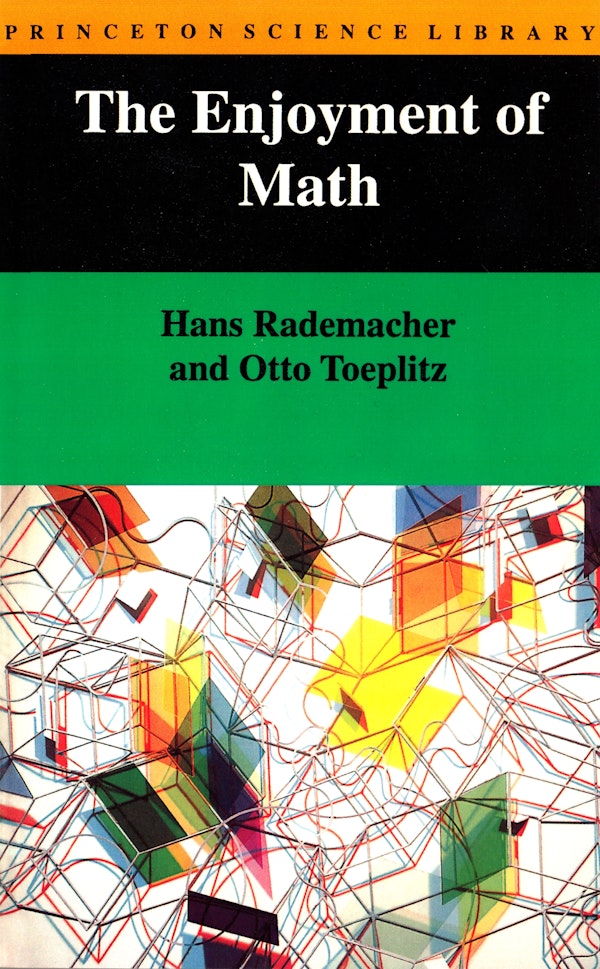
In my view, she enjoys mathematics just the way the great mathematicians Hans Rademacher and Otto Toeplitz have said in their amazing book, The Enjoyment of Math.

I am wary of giving a quiz to young children. If the quiz is too tough, like most of us, they may lose confidence and if the quiz makes students plainly apply known algorithms, they may be bored or become overconfident. It is a delicate balance.

I have tried to apply sound principles. Here are the instructions to the quiz:

  1. Sit in a comfortable place with all the things you need: mostly a pencil and a lot of paper. This is an open-book exam in that you can refer to your notes and use a calculator. Just don’t Google the problem statement. 
  2. Be honest.
  3. Read the problem carefully. Draw diagrams. Use Geogebra if you like. No need to curb creativity. Don’t hesitate to ask if something is unclear.
  4. Try to stick to the time, but it is okay if you run over.
  5. The correct answer to each problem carries certain points (indicated against the problem number), but that’s not why we are writing this exam. The goal for me (as a facilitator) is to understand if I need to change my method of instruction and reinforce certain topics, whereas the goal for you should be to just enjoy solving the problem. Show your work.
  6. Take the quiz right here on this doc (provide answers inline). Of course, you can take a picture of your rough paper-pencil work and stick it here. Neatness matters but content is more important than form.

And here is the quiz in its entirety. Take a look. I hope you enjoy it. It contains Rujuta’s solutions and our discussion: https://docs.google.com/document/d/1xHOM5MSP9OFMPDUTruQ6ty1LZbKHwvjex3LcMo9rHkI/edit?usp=sharing

Choosing Physics Resources for the First Year of a Self-paced Study

Rujuta is now willing and prepared to study Physics! She would have been in the eighth grade in a traditional school and we were thinking of how to study beginning physics. She asked me to come up with a “curriculum of sorts”. I gave it a try and here is how we are going to spend some of our time (this is an image, see the link below it for the entire article):

Here is the link to the entire article. It is written as an introduction to her class notes. It reflects our thinking at the moment and how we are collaborating.

Physics is entertaining, all-encompassing, and, in most cases, a pursuit of a lifetime. Of course, a lifetime pursuit of anything is for a thorough professional of a trade, but its enjoyment in its formative stages is for everyone.

I hope we enjoy this exciting journey!

How to Do Research …

Paul R. Halmos had been a great teacher, educator, author, and, of course, mathematician. He wrote eloquently about his life’s journey as a mathematician in what he called his “automathography”: I want to Be a Mathematician. It is a book with a lot of mathematics (higher) but it also has a high literary value. He writes forcefully. His writing is quite original, thought-provoking, and effective. I might write about the book later, but, for now, I want to draw your attention to an essay, How to Do Research, from his book. Here are the opening lines (it is an image, emphasis mine):

Beautiful, isn’t it? True of most of us, isn’t it? What is also interesting about it is that it not only applies to formal, professional “research”, but also to everyday problem-solving, investigation of things that intrigue you. In other words, it is about researcher’s attitude.

AMS (American Mathematical Society) has been kind enough to publish this essay in its entirety. Here is the link to it in PDF: https://www.ams.org/notices/200709/tx070901136p.pdf

MINDSTORMS

That is the main title of a life-changing book, at least for some. The subtitle is Children, Computers, and Powerful Ideas. Its author is Seymour Papert, who was a mathematician and educator.

I am still reading the book and will shortly do a longer post. But if you can’t wait to experience some powerful writing, please read the book. The MIT media lab and Seymour Papert’s family have made this book available for us to read for no charge. Making such a wonderful book (that is still in print) available for the general public for no charge is a truly generous gift. Here is a specimen of Papert’s writing (from Chapter 2: Mathophobia) —

PLATO WROTE over his door, “Let only geometers enter.” Times have changed. Most of those who now seek to enter Plato’s intellectual world neither know mathematics nor sense the least contradiction in their disregard for his injunction. Our culture’s schizophrenic split between “humanities” and “science” supports their sense of security. Plato was a philosopher, and philosophy belongs to the humanities as surely as mathematics belongs to the sciences. 

This great divide is thoroughly built into our language, our worldview, our social organization, our educational system, and, most recently, even our theories of neurophysiology. It is self-perpetuating: The more the culture is divided, the more each side builds separation into its new growth. 

This is marvelous writing, even life-changing, especially if you are an educator!

Installing Ubuntu on a new laptop

Recently, I got a new laptop and I had one main job: install the Ubuntu operating system. My dad had given me the USB Ubuntu boot drive, so I went to Windows’ BIOS setup. At first, I didn’t know how to start. But then, I simply searched how to get to the BIOS setup and everything became quite clear.

When I went to the BIOS setup, it asked me what I wanted to do, I wanted to use the boot drive, so I simply clicked on the “Use a device” option. After I clicked on that, it showed me six different options: two USB ports (as in devices connected to the USB ports) and four other device options which did not make much sense to me. I realized I had inserted the drive into the first USB port, so clicked on that option.

After that, the system started installing, and soon I was looking at a screen that asked me whether I wanted to try Ubuntu or directly install it. I selected the “Install Ubuntu” option and along came a series of questions asking how I wanted my setup to be. These questions asked about my preferred keyboard layout, updates and software preferences, my preferred installation type, my current location, and my login details. (This part was fairly easy for me because I upgraded another device the same way.)

Next, all the Ubuntu packages were downloaded and installed, and I restarted my laptop in order to use the new installation. There it was! The newest version of the Ubuntu operating system.

The last thing I checked was if my Windows setup had been affected. I restarted my laptop, and this time selecting the Windows option, checked if everything was alright. I went to my Windows login, and could see no errors or major changes. The Ubuntu installation was a success.

Calculus: Of the Students, By the Students, and For the Students

We are happy to announce that we are doing a calculus group discussion on the Internet! I have not seriously researched if this the first ever such attempt, but it looks like an uncommon one.

Apoorv and I have written about it in detail here. Please take a look and let people know.

We expect to start in the first week of October 2022!

Sums of Consecutive Integers

Number theory problems can be some of the most difficult problems, but they are usually the most interesting and satisfying to solve. Recently, I was tasked with finding the solution to this problem: Find out which positive numbers cannot be expressed as the sum of two or more consecutive positive integers.

The first thing we can do is to try some small numbers. After trying a few, a pattern starts to emerge. All the powers of 2 seem to be the only numbers unable to be expressed as the sum of two or more consecutive positive integers. Although this is a pattern, we can only say that this pattern holds for small numbers. Now this question arises: Can we prove that this holds for all numbers, that only powers of two cannot be expressed as the sum of two or more consecutive positive integers?

Initially, I was unsure how to go about this. So I decided to find the numbers that could be expressed as a sum of two or more consecutive positive integers to help find the numbers that could not.

Since any odd number can be represented as 2n+1, and 2n+1 = (n)+(n+1), all odd numbers greater than one can be expressed as the sum of two consecutive positive integers. Let us call this statement A.

However, I could not figure out what to do after that. After thinking about it for a while, I remembered an old trick I had discovered. Any number i that is divisible by an odd number n can be represented as the sum of n consecutive integers centered around i\div n. For example, the number 40 is divisible by the odd number 5 (i = 40, n = 5). Then, the trick states that 40 is equal to the sum of five integers centered around 8. Indeed, we see that 6+7+8+9+10 = 40 The proof for this is quite simple (omitted here), but it suffices to say that it works because the sum of every pair of numbers around i\div n is equal to n. Hence, all numbers divisible by an odd number can be expressed as the sum of consecutive integers.


Combining statement A and statement B, we find that all numbers that are divisible by an odd number can be represented as the sum of two or more consecutive integers.

To find out whether a number is divisible by an odd number, we find its prime factorization. Since 2 is the only even prime number, if the prime factorization contains any number besides 2, the number is divisible by an odd number, and it can be represented as the sum of consecutive integers. The only numbers that do not fit into this category are the numbers whose prime factorizations contain only 2. In other words, the only numbers that cannot be expressed as the sum of two or more consecutive positive integers are the powers of 2 (1, 2, 4, 8, …).

This proof was the result of thinking by myself as well as fruitful discussions with my father. He was trying to solve the problem too, and at a point when we were both stuck, we sat down together and shared our separate insights, and soon after, we figured it out. This was a great example of how working together can help both parties because I would have taken much longer to solve this problem without his input (if I would have solved it at all!).

A Function Composition Problem

A topic that has resurfaced during my undertaking of calculus this year has been function composition. During the year, I have been drawn toward the concept of function composition, something that was evident to my father. One day, as we sat down to begin our class, he posed this problem to me:

f(x)=3x+2=\underbrace{(g\circ g\circ g\circ ... \circ g)}_\text{100  times}(x).
Find g(x).

I believe this is a very interesting problem. You should take a pencil and paper and sit down to solve this problem—it is slightly difficult to solve in your head. Here is my solution:

First, I realized that g(x) must be a linear function. Since the functions are composed, the degrees of the polynomials will multiply because the function is raised to the degree of the polynomial. For example, if g(x) = x^3, g(g(x)) = (x^3)^3 = x^{3\cdot 3} = x^9. Hence, the function must be a first degree polynomial. As such, the function g(x) can be represented by the expression ax+b, where a and b are real numbers. Next, I listed g(x), g(g(x)), and so forth, a few times, to try and find a pattern. To clarify, the notation g^n(x) means g(g(g(...(g(x) n times.

g^1(x) = ax+b

g^2(x) = a(ax+b)+b = a^2x+ab+b

g^3(x) = a(a^2x+ab+b)+b = a^3x+a^2b+ab+b

g^4(x) = a(a^3x+a^2b+ab+b)+b = a^4x+a^3b+a^2b+ab+b

From these four iterations, a pattern started to emerge:

g^n(x) = a^nx+a^{n-1}b + a^{n-2}b+...+ab+b = a^nx+b(a^{n-1}+a^{n-2}+...+a+1) = a^nx + b(\frac{a^n}{a-1})

We can equate g^{100}(x) to 3x+2 and find a and b.

3x+2 = g^{100}(x) = a^{100}x+b(\frac{a^{100}}{a-1})

We can equate the degree 1 terms to find a:

3x = a^{100}x

3 = a^{100}

a = 3^{1/100}

Using a, we can find b.

2 = b(\frac{a^{100}}{a-1}) = b(\frac{{(3^{1/100})}^{100}}{3^{1/100}-1})

b = \frac{2}{3}(3^{1/100}-1)

Hence, g(x)=ax+b=3^{1/100}x+\frac{2}{3}(3^{1/100}-1).

Bertrand Russell’s Gem

The functions of a Teacher compared to that of the Propagandist

No one can be a good teacher unless they have feelings of warm affection toward their pupils and a genuine desire to impart to them what they believe to be of value.

This is not the attitude of the propagandist. To the propagandist the pupil is a potential soldier in an army. They are to serve purposes that lie outside their own lives, not in the sense in which every generous purpose transcends self, but in the sense of ministering to unjust privilege or to despotic (meaning: of a cruel and oppressive ruler) power. The propagandist does not desire that the pupil should survey the world and freely choose a purpose which to them appears of value. The propagandist desires, like a topiarian (meaning: ornamental gardening) artist, that the pupil’s growth shall be trained and twisted to suit the gardener’s purpose. And in thwarting the pupil’s natural growth the propagandist is apt to destroy in them all generous vigor, replacing it by envy, destructiveness, and cruelty.

There is no need for human beings to be cruel; on the contrary, I am persuaded that most cruelty results from thwarting in early years, above all from thwarting what is good.

Bertrand Russell, Unpopular Essays (1953), Ch. VIII: The Functions of a Teacher, p . 118-9 (emphasis mine)

Russell is of course a great philosopher-mathematician of the 20th century. His honest commentary on various issues is always a joy to read. The above quote is no different. As I reflect upon my teaching and learning sessions with my children, I couldn’t agree more with what he has said. In the 21st century, knowledge should really be free. I know that this is not true for many people yet, but I am hopeful that the barriers to entry will be reduced as the Internet becomes more and more ubiquitous and accessible.

But if the so-called “programmers of the society” in the form of disciplinarian teachers, despotic generals, selfish politicians keep coming in the way of an obvious freedom, then we have a long way to go. Circumstances, a personal make-up, behavioral traits themselves are so challenging to individuals that we do not want the societies to be programmed.

And a selfless affection without any hidden motif (even that of imparting knowledge of certain kind) is the only thing we need in capable teachers.

My Experience With Omicron

The RT-PCR report came back positive at one in the morning on Sunday, January 29, 2022. That night, I wasn’t feeling so great. I had a slight fever and a little headache.

Since then, it has been a whole week. I don’t have any symptoms but I am utterly bored. After Tuesday, February 2nd, I have been completely fine. But then again, I still had to be isolated just in case I still had the virus because, of course, I didn’t want to infect anybody.

My main problem with quarantine was that I couldn’t see or talk to anybody. I’m so used to talking to my brother or my parents and when I was in quarantine, I was “cut off” from them which was quite difficult for me.

Two weeks before, my brother was also quarantined because he had COVID but he was doing all right in terms of staying alone in his room. At that time, I started to think about how it would be if I were quarantined. My guess was that I would have been alright because I would look forward to ending the quarantine.

This was surprisingly hard because I found that I was bored and tired and couldn’t focus much. A few times I tried to distract myself by doing some assignment or doing some math problem but I noticed that I couldn’t focus simply because I wasn’t feeling very motivated.

That comes to the next topic of quarantine: feeling motivated. In our daily lives, we get a lot of inspiration from the things around us. We sometimes look out the window, go for short walks, talk to the people around us to get that daily inspiration. Now, when you’re stuck in a room for a week with not much to do, where is that inspiration going to come from?

I was so glad when my quarantine ended on Sunday. I was almost bouncing off the walls in my house! I guess the most important thing to learn from this experience is not to take for granted the freedom to roam around even your own house!

Design a site like this with WordPress.com
Get started








